Case study · 03

noryX — the first product

The product that brought me to SusTern — live when I joined in May 2025, and mine to modernize. I rebuilt the experience: new navigation and search, an agent chat that carries the full business context, and a guided onboarding flow. The pattern it set still runs through everything since: the AI does the work, the human stays in the loop.

Role
Product & UX design lead
Company
SusTern
Timeline
Live since Feb 2025 · joined SusTern May 2025
Scope
Shopify app · UX modernization · AI growth automation

In shortRebuilt the UX post-launch in 2025 · the review-and-apply pattern the platform adopted · live on Shopify since Feb 2025, 5.0 across the first reviews.

01

The scene: six thousand products, one person

noryX started from the smallest possible user: the Shopify merchant with a catalog too big for their time. Acquisition costs climbing on one side; six thousand products on the other; and a week that disappears into the growth work — metadata, blogs, campaigns — instead of the business.

The data to make better calls already exists — Google Analytics, Search Console, inventory, sales — but it lives in five tabs, and nobody has time to read it. The gap isn't data. It's the next move.

When I joined in May 2025, noryX was live — and the interface hadn't kept pace with the engine. Dated patterns; little of the modern UX/UI craft the product had earned. My first job was the retrofit: new navigation and search, an agent chat that carries the full business context, a guided onboarding flow — and under all of it, a modern design system, with the developer team coached into owning its principles. A modern layer over an engine that already worked.

02

The constraints

  • Trust is the feature.The app changes live product pages at catalog scale. Merchants defend their brand voice and their pricing — so automation lives or dies on guardrails and review.
  • From 25 SKUs to 50,000.A free tier of 25 products has to demonstrate the same idea that a 50,000-product plan depends on.
  • AI search rewrote the rules.Visibility increasingly comes from machines reading the catalog — structured data, schema, FAQs. Optimizing for AI search isn't a channel test anymore; it's table stakes.
03

The decisions

Two sets of decisions shape this story: the founding bets — made before I arrived, and still right — and the retrofit that rebuilt the experience around them.

The founding bets

Automation with guardrails — never silent edits

The bet

noryX generates and prepares the changes — SEO metadata, image alt text, structured data, FAQs, descriptions — then runs them through a review-and-apply flow, at catalog scale.

Why it won

A small team will hand a machine their catalog only if they can see and control what it does. Trust compounds; surprises don't.

The alternative we rejected

Silent auto-apply (fast to demo, hard to trust), or manual assistance only (no leverage).
Insights arrive as actions

The bet

Unify GA4, Search Console, inventory, and sales into recommendations stated as next moves — products to fix, content to publish, bundles to launch.

Why it won

Small teams don't lack data; they lack the next move. When the insight is “publish this draft,” the value is legible in minutes — not quarters.

The alternative we rejected

Another analytics tab that shows charts and stops.

One companion, not five subscriptions

The bet

SEO, content, inventory intelligence, and a chat companion in one app.

Why it won

A solopreneur's attention and budget are the real constraints — and a bundle suggestion is only useful when it knows your stock, not just your traffic.

The alternative we rejected

Point solutions: an SEO app, a blog app, an inventory app, stitched together by hope.

What was ruled out

  • Silent edits by default — review first, with auto-apply as an explicit merchant choice
  • Another analytics tab — insights arrive as actions
  • Five subscriptions — one companion, not a tool stack

The retrofit

An agent with the business in its head

The bet

The assistant isn't a help widget — it reads the store: catalog, inventory, analytics, campaigns — and answers with the next moves, in context.

Why it won

Context is what turns advice into action. An assistant that already knows the business can skip the re-explaining and go straight to the work.

The alternative we rejected

A generic AI chat bolted onto the sidebar — fluent, but blind to the business.

Modernize the shell; keep the engine

The bet

Rebuild the surface around the engine: new navigation and search, a guided onboarding flow, and a modern design system beneath — its principles coached into the developer team, not just handed over.

Why it won

The engine had already earned the merchants; the interface was the gap. And principles the team understands are what keep the standard after the redesign ships.

The alternative we rejected

Patch the old patterns screen by screen — or a redesign that forces merchants to relearn the product.

04

The work

Captures from the same demo store: the product as I found it, a working sketch, and the shipped interface. Demo data throughout — the live product is on the Shopify App Store.

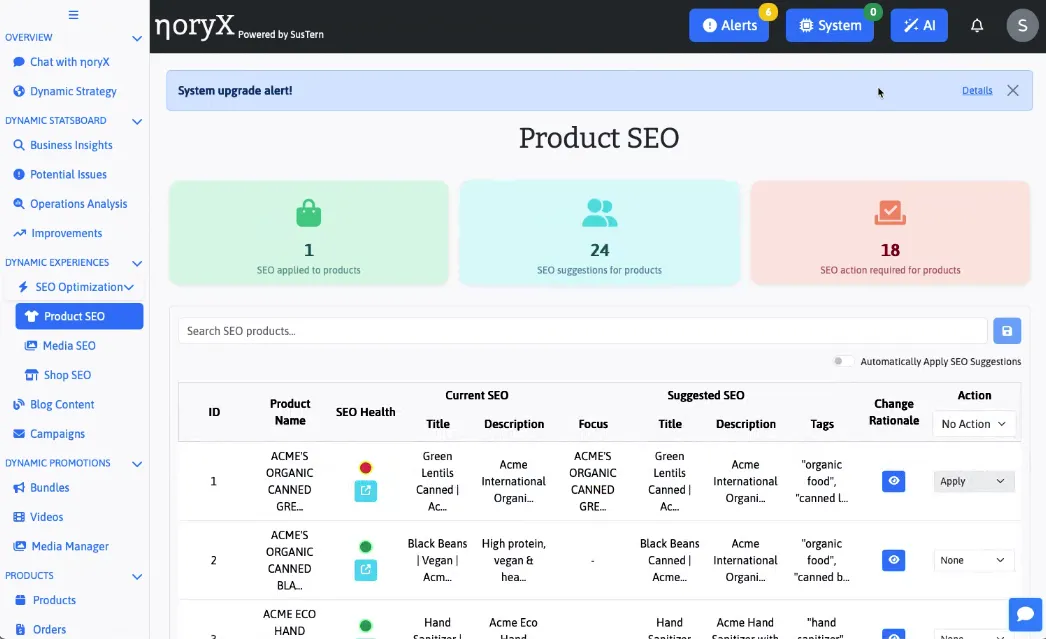
Legacy noryX Product SEO screen — dark shell, stat cards, and a dense suggestions table with apply actions
Legacy captureThe product as I found it: a dark, dense shell — the next action buried inside columns of SEO suggestions.
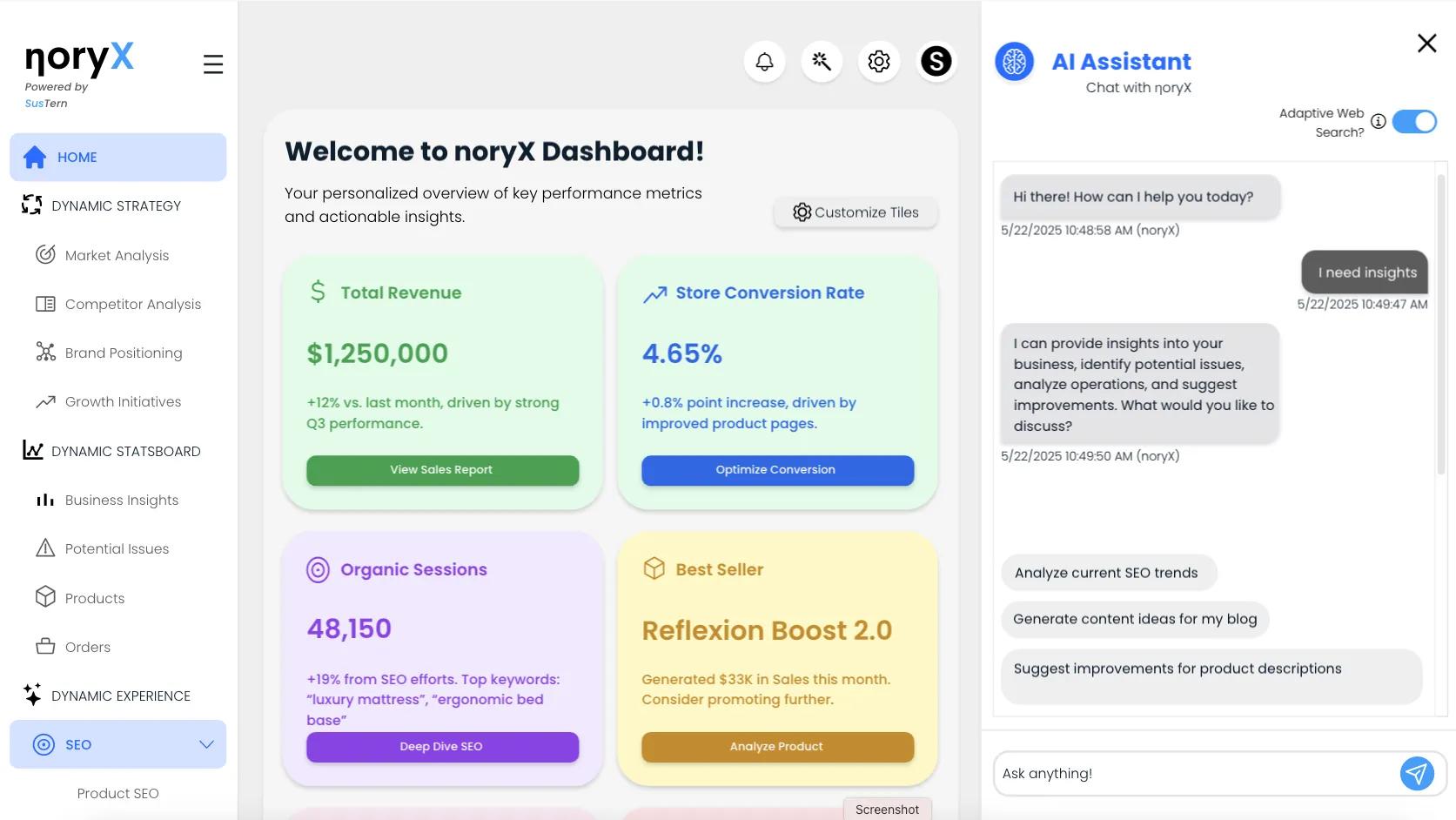
Dashboard sketch — sidebar, welcome hero, and an AI Copilot panel with chat and suggested prompts
Working sketchThe bridge before the first mock: the new shell sketched out — navigation, search, and the AI panel, side by side.
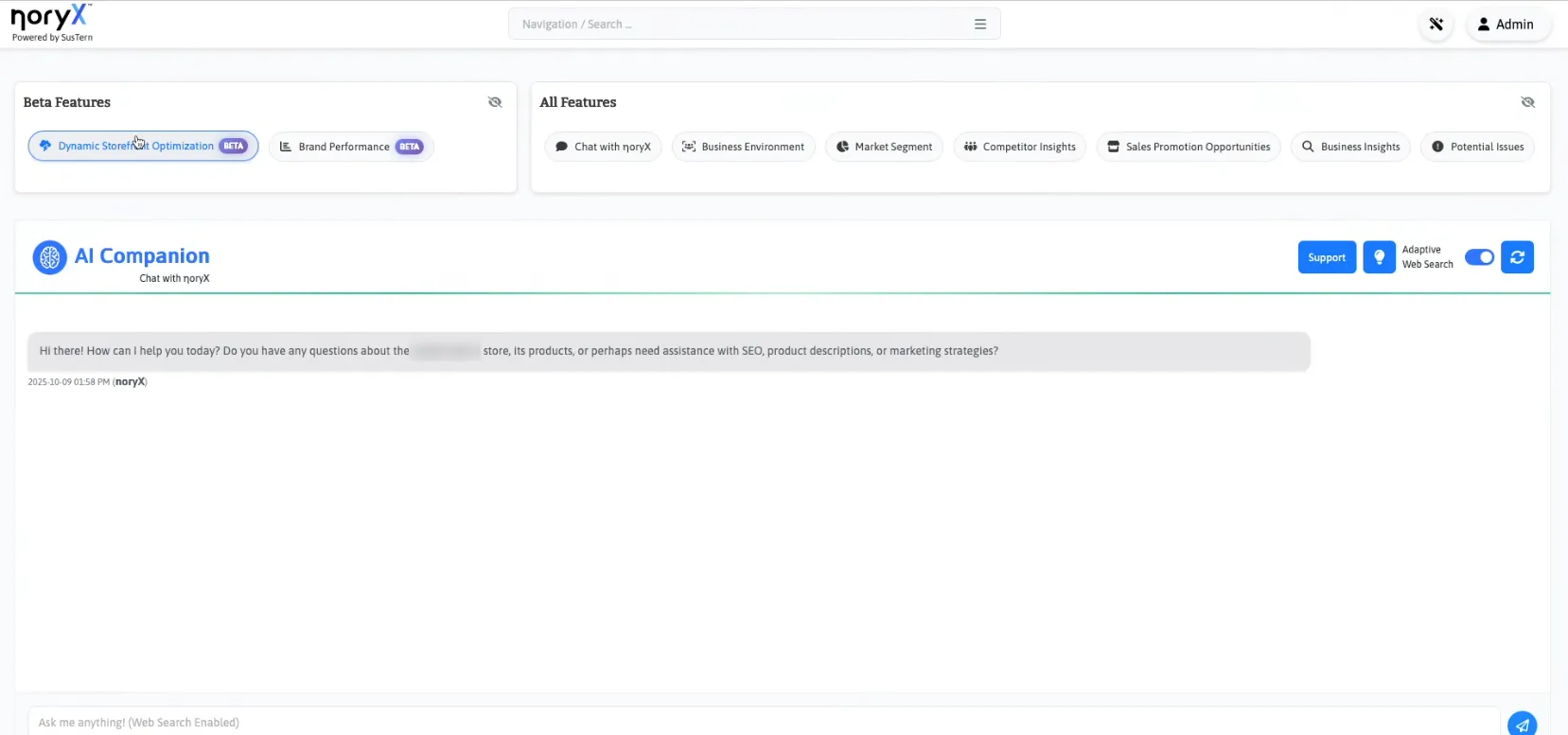
Modernized noryX home — global navigation and search bar, feature shortcuts, and the AI Companion chat
Sanitized captureThe modernized shell, shipped: navigation and search up top, the AI Companion carrying the store’s context one click away.
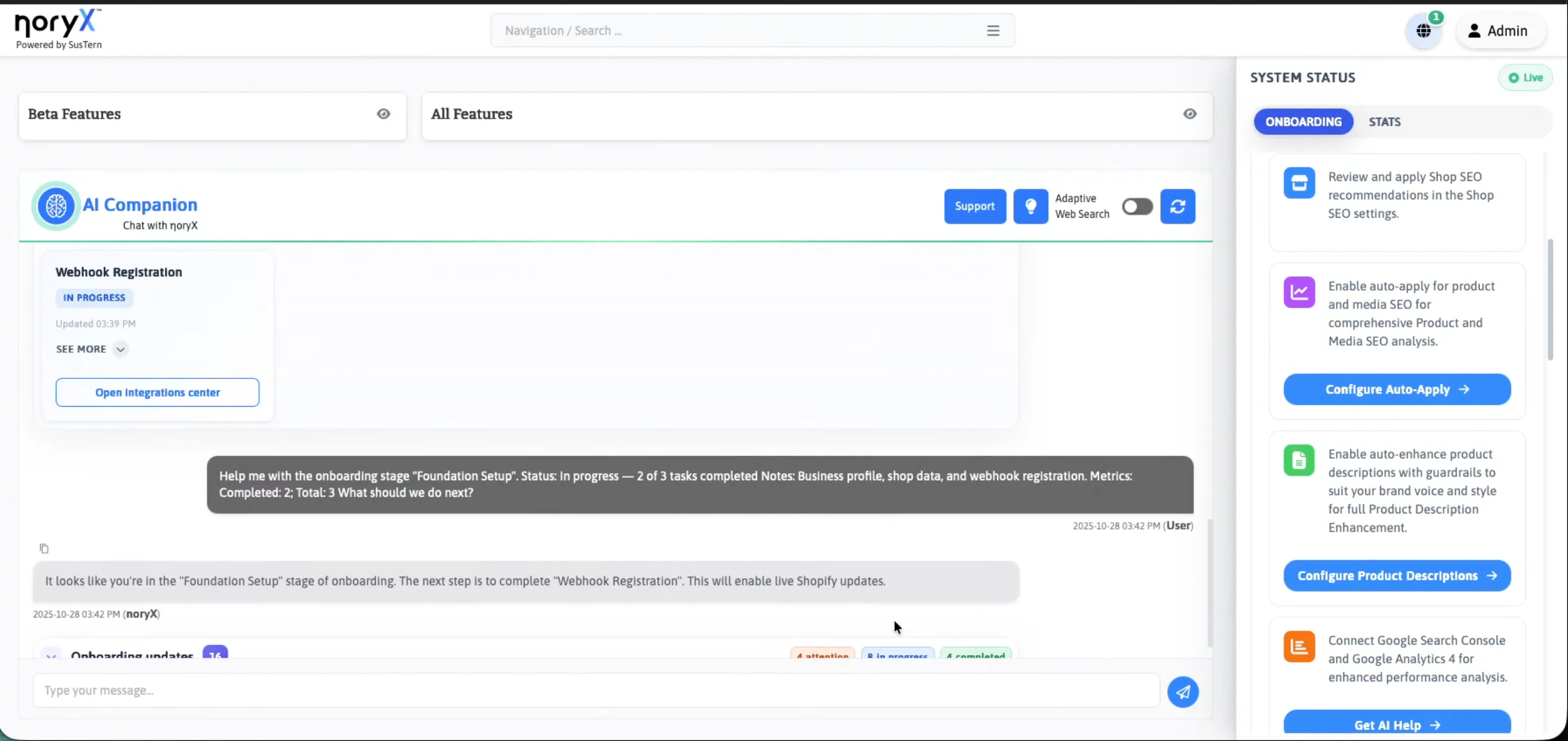
AI Companion guiding an onboarding stage beside a System Status panel with setup tasks and next steps
Sanitized captureGuided onboarding, shipped: the Companion walks operators stage by stage — the status panel shows exactly where they are.

How this shipped

  1. Audit

    The live product, audited: an engine that worked, an interface that hadn't kept pace

  2. Decide

    Keep the trust model — review-and-apply, a human at every commit — and rebuild the experience on top of it

  3. Ship

    New navigation and search, an agent chat with business context, guided onboarding — into a live product

  4. Govern

    A modern design system and its principles — coached into the developer team

05

Impact & status

Live on the Shopify App Store since February 2025, with plans from free to $329/month as catalogs scale from 25 to 50,000 products. Early reviews are five stars. The marketing version of the facts lives on the listing; this is the design version.

Feb 2025live on Shopify
5.0early store rating
25 → 50,000products, one app
4plans, free to $329/mo

What noryX proved inside SusTern: review-and-apply is the pattern merchants trust, and AI advice gets sharper when it knows your inventory as well as your traffic. It also raised the bigger question — what if the whole operation lived in one system? I made that case next: the platform, where both ideas now run end to end.

“The auto tagging of all our pictures with actual descriptions is huge! They also optimize for AI, plus learn the business in a matter of days in a way no other tool has. They provide business insights, blogs, auto-make product bundles and promos — I check in once a day, hit publish, and I'm good to go.”

Main Street Collective L.L.C · Shopify App Store review, June 2025

“Time and resources are always limited — and that's exactly where noryX has made a huge difference for my business. noryX has saved me hours each week, and more importantly, it's saved me money by reducing the need to outsource content and strategy tasks.”

RENVETA · Shopify App Store review, April 2025

Public reviews from the Shopify App Store listing — lightly edited for length and clarity. They vouch for the engine; the interface work came next.

06

What I'd do differently

I'd make the review experience even more central. Batch review at catalog scale is where trust is won — it deserves to be the first screen, not the last step.

And I'd publish the guardrail list as a product feature: plain words for what the AI will never touch without a human. The constraint is the selling point — say it on the label.